

In today’s B2B agri-food environment, environmental compliance has become a decisive criterion when selecting suppliers. As a breadcrumb manufacturer committed to sustainability, at Frumen we have developed a rigorous, traceable, and transparent industrial waste management system designed to create real value for our clients.
This policy goes beyond regulatory compliance: it is integrated as a strategic part of our value proposition for large manufacturers, HORECA chains, private label brands, and exporters who value suppliers with solid, documented, and auditable environmental structures.
Our waste management system is designed to meet two key objectives:
- Strictly comply with legal and regulatory environmental requirements.
- Deliver added value to our industrial clients through data, traceability, and verifiable best practices.
To achieve this, we work with authorized waste managers, enabling us to guarantee our clients:
- Proper segregation, collection, and treatment of waste.
- Traceability of waste flows with monthly documentation.
- Alignment with sustainable procurement systems and ESG audits.
Structure and traceability: how we manage waste
Our internal management system is based on:
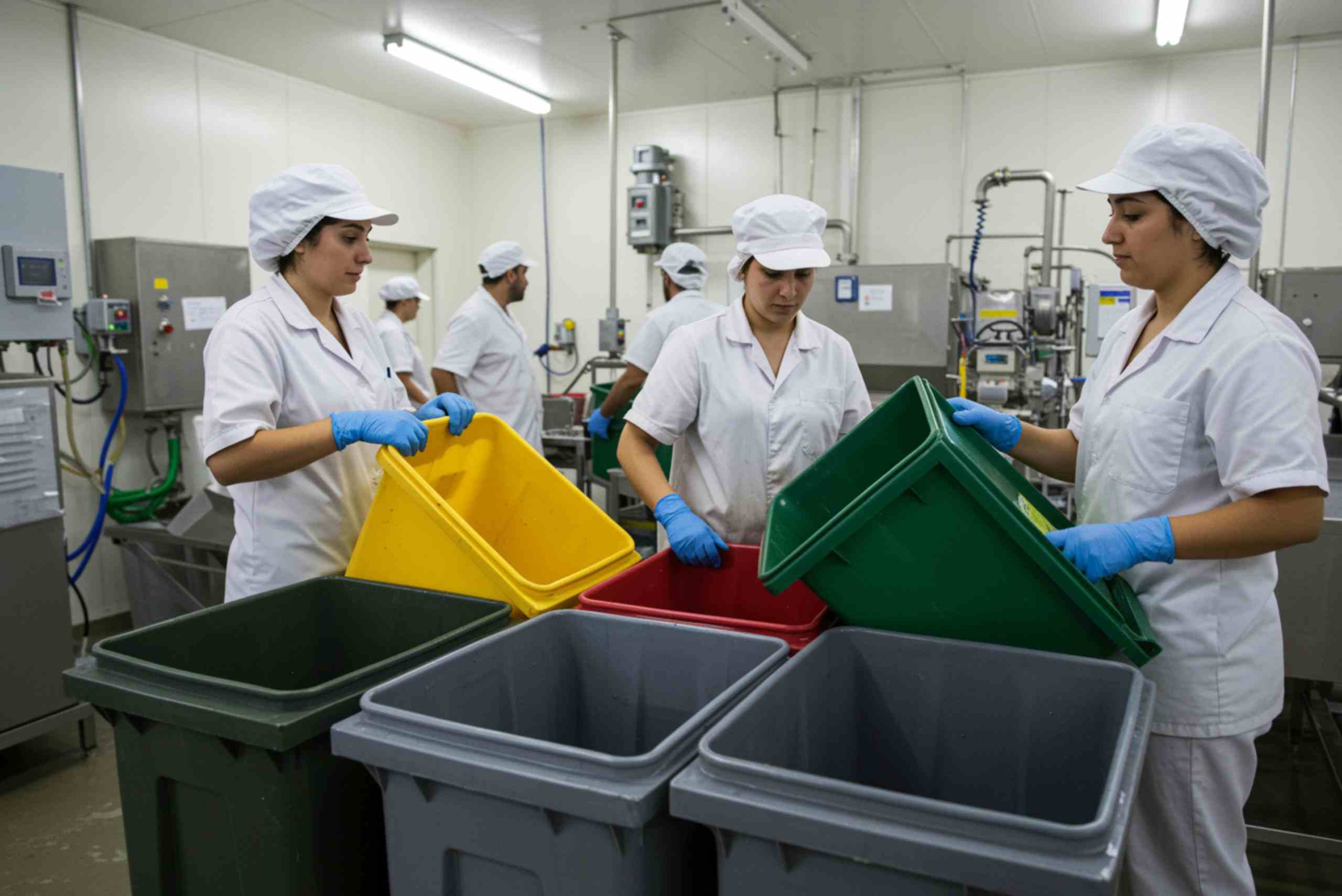
- Selective separation by waste type and color coding across all work areas: offices, cafeteria, and production.
- Application of the European Waste List (EWL) for proper classification.
- Differentiated management of hazardous waste, with specific temporary storage, labeled containers, and certified removal.
- Mandatory monthly documentation with waste managers, reviewed by the environmental manager.
This process allows us to provide verifiable reports and to supply our clients with the information they need for their own environmental compliance processes, tenders, or corporate reporting.
Reuse and circular economy: waste as a resource
In addition to traditional management, at Frumen we apply circular economy–oriented measures such as:
- A closed-loop system for reusable pallets, reducing wood consumption and packaging transport.
- Daily collection of organic production by-products, avoiding unnecessary accumulation and improving traceability.
- Application of the source reduction principle, minimizing waste due to rejection through in-line quality control.
These processes not only optimize internal efficiency but also provide direct benefits to our clients in terms of traceability, product sustainability, and responsible positioning.
Awareness and training for a cleaner industry
At Frumen, we understand that no system works without people’s involvement. That is why internal training is a core part of our waste management policy.
We organize regular training sessions, including initiatives in collaboration with recognized waste management operators, aimed at:
- Production staff and line operators.
- Supervisors, quality technicians, and maintenance teams.
- Office staff and administrative areas.
This cross-functional awareness ensures practical compliance with the system, enables continuous improvement, and allows us to respond effectively to the evolving requirements of our B2B clients.
What value does this waste management system bring to our industrial clients?
An increasing number of high-level clients—advanced food manufacturers, organized restaurant chains, and international distributors—now include environmental criteria in their supplier approval and purchasing processes, such as:
- The existence of documented management systems.
- Recognized certifications (Ecoembes, authorized waste managers).
- Reduced regulatory and reputational risk.
- The ability to provide ESG reports or environmental data.
As a breadcrumb manufacturer, our advanced waste management system represents a strong argument for:
- Tenders with sustainability criteria.
- Audits by large accounts or international distributors.
Co-branding or private label strategies aligned with environmental values.
Leave A Comment