

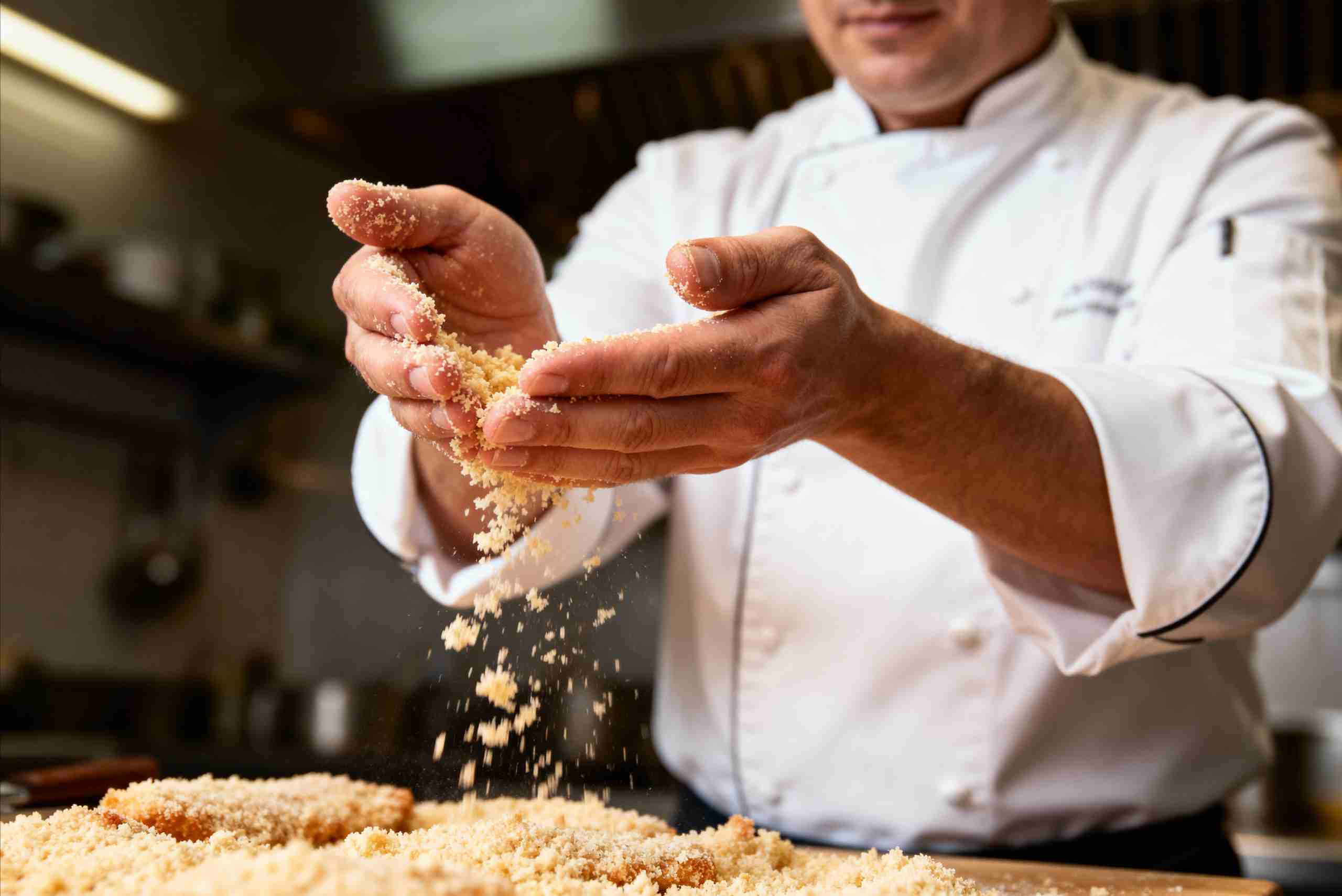
As a breadcrumb manufacturer, your value proposition must go beyond functionality and nutrition: texture, color, shape, and even the sound of the coating (that satisfying “crunch”) play an essential role in how chefs and food manufacturers perceive quality.
Why Do Sensations Matter So Much in Breadcrumbs?
- When a professional buyer (chef, food service, or industry) chooses a breaded product, they don’t only consider the ingredients or cost — they value the sensory experience: appearance, texture, crispness, uniformity, and the sound when breaking or chewing it. Studies on crisp texture perception show that it significantly influences the acceptance of the final product.
- The microstructure of the coating (granulometry, porosity, thickness, adhesion) directly impacts these sensations. Changes in crumb size, distribution, and coating porosity affect how much sound the breading makes when breaking, how uniform it looks, and how golden or thick it appears.
- Even the sound of the crunch affects the perception of freshness and quality: sharper, more defined sounds enhance the feeling of a fresh and crispy product.
How the Sensory Attributes of Breadcrumbs / Breading Influence Professional Perception
| Sensory Attribute | What Professionals Look For | How Formulation or Supplier Product Can Influence It |
| Color of the coating (golden tone, uniformity, appeal) | Visually appetizing and consistent results in every batch. Uneven or burnt tones reduce the perception of quality. | Adjust the breadcrumb or coating formulation to achieve the desired tone (composition, flour type, pretreatment, thickness, particle size, frying or baking parameters, time, and temperature). Correct tone through crumb blending, pretreatments, toasting, or moisture control. |
| Crumb shape and size / granulometry | Too coarse: rough or weak adhesion. Too fine: loses crunch or feels heavy. Preferences vary by product type (meat, fish, vegetables, snacks, etc.). | Choose the right crumb size for the channel: coatings for deep frying, frozen, regenerated, air fryer, oven, etc. Validate through sensory prototypes which granulometry the target market prefers. Adjust coating density for batch consistency. |
| Adhesion / coverage uniformity | Avoid “bald spots” or detachment during handling, cooking, or regeneration. Uniform visuals and secure crumb adherence reduce waste and enhance image. | Use preliminary coatings (adhesive or predust) when the food’s shape or surface requires it. Control humidity, viscosity, and temperature as needed. Choose formulas that maintain adhesion even under demanding processes (freezing, regeneration, high temperatures). |
| Crunch / sound when biting | Perception of freshness, quality, and a premium texture. A clear crunch indicates freshness and structural integrity. | Formulate for optimal crunch: control pore structure, coating fragility, and number of fracture points. Avoid overly dense or absorbent coatings. Consider blind sensory testing. |
| Oil absorption / coating thickness | Professionals and end consumers prefer products that don’t feel overly greasy and maintain texture without becoming saturated. Also affects cost, product weight, and perceived nutritional value. | Adjust formulations to minimize oil absorption without losing crispness or coverage. Test lighter coating variants (e.g., light tempura or less oily blends). Balance coating cost with sensory performance. |
| Batch-to-batch consistency | Same look, texture, and sound in every production run. Inconsistent coatings lead to professional rejection. | Offer standardized, well-tested formulas with clearly defined quality criteria. Suggest operational parameters, testing phases, and sensory control protocols. |
Sensory Guidelines for Choosing Coatings by Professional Profile
Depending on the professional target, some sensory aspects matter more than others. Below are guiding recommendations:
| Professional Profile / Channel | Key Sensory Preferences | Breading Recommendations (crispness, absorption, thickness, crumb size, etc.) |
| Gourmet / Premium Differentiation | High crunch definition, pronounced texture, strong adhesion, deep golden tone, consistent texture, premium feel. | Slightly coarse crumb with porous internal structure for audible crunch. Strong adhesion, minimal detachment, controlled oil absorption. Use of pretreatments or adhesion enhancers recommended. |
| Fast Food / Snacks / Deep Fryers | Quick cooking, consistent texture, immediate and strong crunch, appealing golden color, uniformity. | Medium-to-coarse crumb (“noticeable” texture), strong adhesion, resistant to handling, suitable for freezing. Oil absorption control. Robust formulas. |
| Healthy / Low-Fat / Air Fryer / Oven | Crunch present but not overly greasy; low oil absorption; attractive appearance; light yet crispy texture. | Formulate lighter coatings; consider light tempura or specialized blends; optimize cooking parameters; adjust thickness and density for crunch vs. oil balance. |
| Children / Kids’ Products | Noticeable crunch, appealing texture, uniformity, safety (doesn’t fall apart), pleasant taste. | Softer coatings if the base food requires it; strong adhesion; perceptible texture when eaten; avoid excessive hardness. |
| Foodservice / HoReCa | Production consistency, uniform presentation, perceptible crunch, ease of handling or regeneration, positive sensory acceptance from end consumers. | Stable, adaptable formulas; pilot testing; clear communication on performance, absorption, and adhesion; options suited to client’s equipment (fryer, oven, air fryer, etc.). |
From Product to Experience: The New Role of the Breadcrumb Manufacturer
As breadcrumb manufacturers, we have the opportunity to sell sensation, quality, differentiation, and consistency.
When professionals perceive uniformity, crunch, visual appeal, and consistent quality in their final products, their confidence, loyalty, and willingness to buy increase.
Breadcrumbs are a sensory vector as important as any other functional ingredient.
When texture, sound, appearance, and adhesion are properly balanced, the final product is not just eaten — it’s experienced.
And that makes all the difference.
Leave A Comment