

In industrial food developments, many decisions are still centered on the price per kilogram of the ingredient. It is a clear reference point, easy to compare and seemingly objective. However, in high-volume production lines—especially for breaded, frozen products or those intended for QSR (Quick Service Restaurants: fast-food restaurants that offer quick service and affordable prices, with a limited menu focused on operational efficiency)—the real economic impact rarely lies in the supplier’s invoice.
The real cost is often hidden in lack of stability.
When a coating system does not provide batch-to-batch stability, variability begins to affect industrial performance, operational efficiency and, ultimately, the margin of the food development.
A Structural Risk in Food Developments
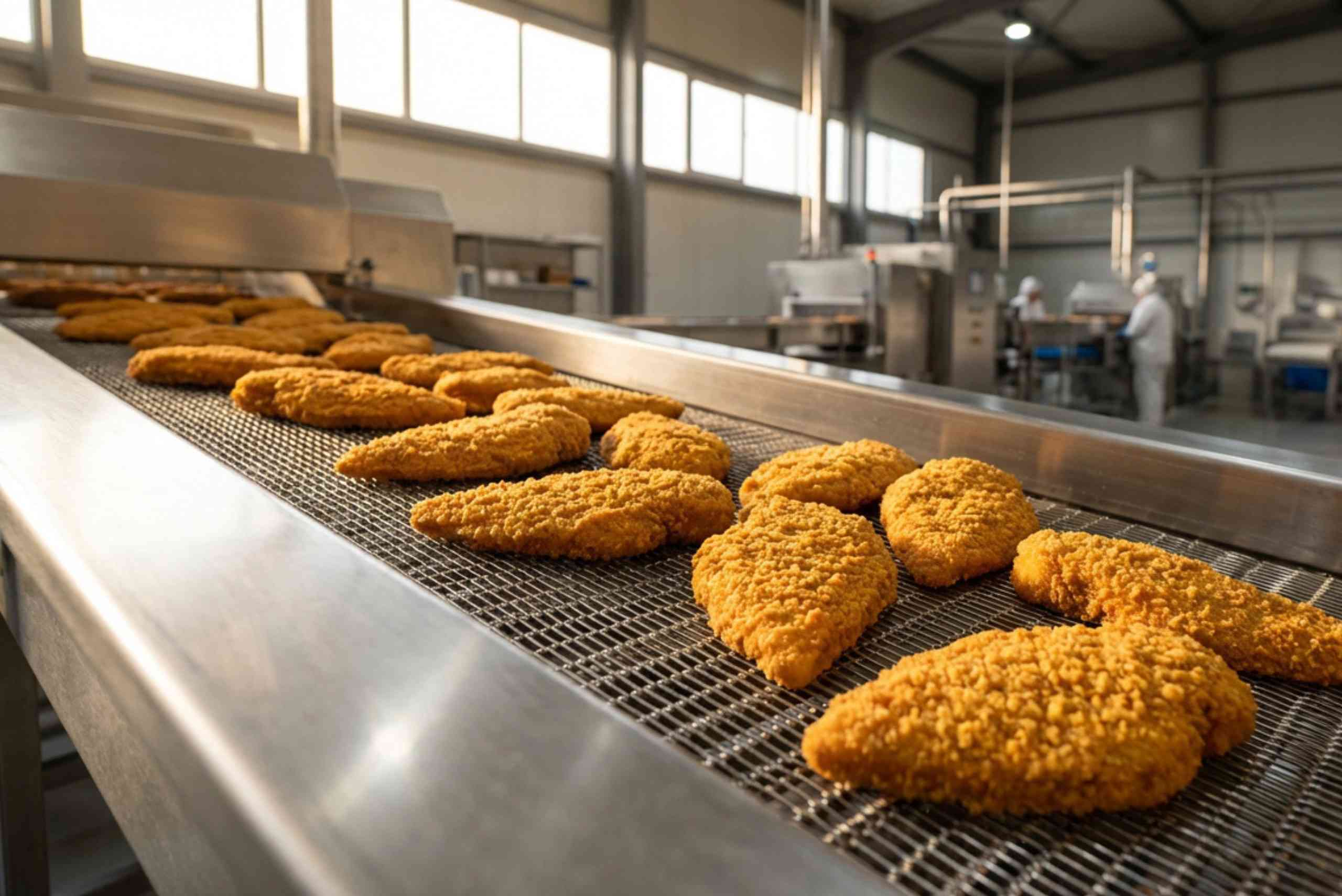
In industrial production, repeatability is the foundation of profitability. Every parameter is calibrated so that the final product maintains:
- The same visual appearance
- The same coverage
- The same thermal behavior
- The same sensory experience
However, small deviations in the coating can disrupt this balance.
A slight variation in particle size distribution can alter texture. A change in golden color tone can affect perceived quality. A small difference in moisture can influence oil absorption or stability after freezing.
In large-scale food developments, where thousands of units are produced per hour, these variations are not anecdotal—they are amplified.
The Operational Impact That Is Not Always Measured
When consistency is not guaranteed, production teams tend to compensate for uncertainty. This usually translates into:
- Overdosing ingredients to ensure coverage
- Constant adjustments to temperature or cooking times
- Preventive increases in safety parameters
- Greater generation of product waste
- Occasional stops for recalibration
Each of these actions may seem minor. However, when repeated consistently over weeks or months, they generate a significant cost increase in industrial food developments.
The Impact on Brand and Customers
In categories such as structured retail and QSR, consistency is a commercial requirement. Consumers expect the product to be identical in every purchase. Any noticeable variation breaks that expectation.
In food developments destined for large chains or export markets, repeatability becomes even more critical. Sustained deviations usually lead to:
- Formal complaints
- Contractual penalties
- Additional audits
- Supplier review processes
Lack of stability does not only affect production; it directly impacts the commercial relationship with customers.
Requirements in Modern Food Developments
Coating in today’s industrial food developments is part of a technical system that must behave predictably under different—and sometimes extreme—conditions:
- Continuous industrial frying
- Oven cooking
- Air fryer regeneration
- IQF freezing
- Multi-format distribution
Stability in parameters such as particle size, moisture, and color is essential to maintain repeatability in the final product.
Consistency is the result of controlled processes and precisely defined technical criteria. For this reason, leading companies tend to prioritize aspects such as:
- Strict tolerance control
- Batch-to-batch stability
- Technical documentation capability
- Specialized support on the production floor
- A long-term collaborative approach
In this context, the supplier stops being just a provider and becomes a technical partner that adds real value to the commercial process by reducing risks and improving efficiency.
At Frumen, we work to turn consistency into a real competitive advantage in every one of our products and custom developments.
If you need it, contact us and let’s talk about your process.
Frequently Asked Questions About Consistency in Food Developments
How does coating instability affect industrial margins?
Variability generates overdosing, higher oil consumption, waste and constant line adjustments, reducing the real margin of the food development.
Which technical variables most influence breading stability?
Particle size distribution, moisture, calibrated color, and thermal behavior during frying and regeneration.
Why is consistency critical for export markets?
Because food developments destined for international markets require repeatability, auditing, and strict compliance with specifications.
Is price or stability more important in food developments?
In high-volume industrial environments, stability protects margins and reduces reputational risks, so it often has a greater economic impact than unit price.
Do you want to evaluate the stability of your food developments?
If you detect deviations in performance, complaints, or variability on the production line, the problem may not be the price… but the system.
Leave A Comment