

Reducing food waste has become a priority across the entire agri-food supply chain. It is no longer simply a matter of sustainability or corporate responsibility; it is also a factor that directly affects business competitiveness, process efficiency and the profitability of production lines.
In this context, the European Union has taken a further step by approving new targets to reduce food waste. One of the most significant is the goal of reducing food waste generated during food processing and manufacturing by 10% by 2030.
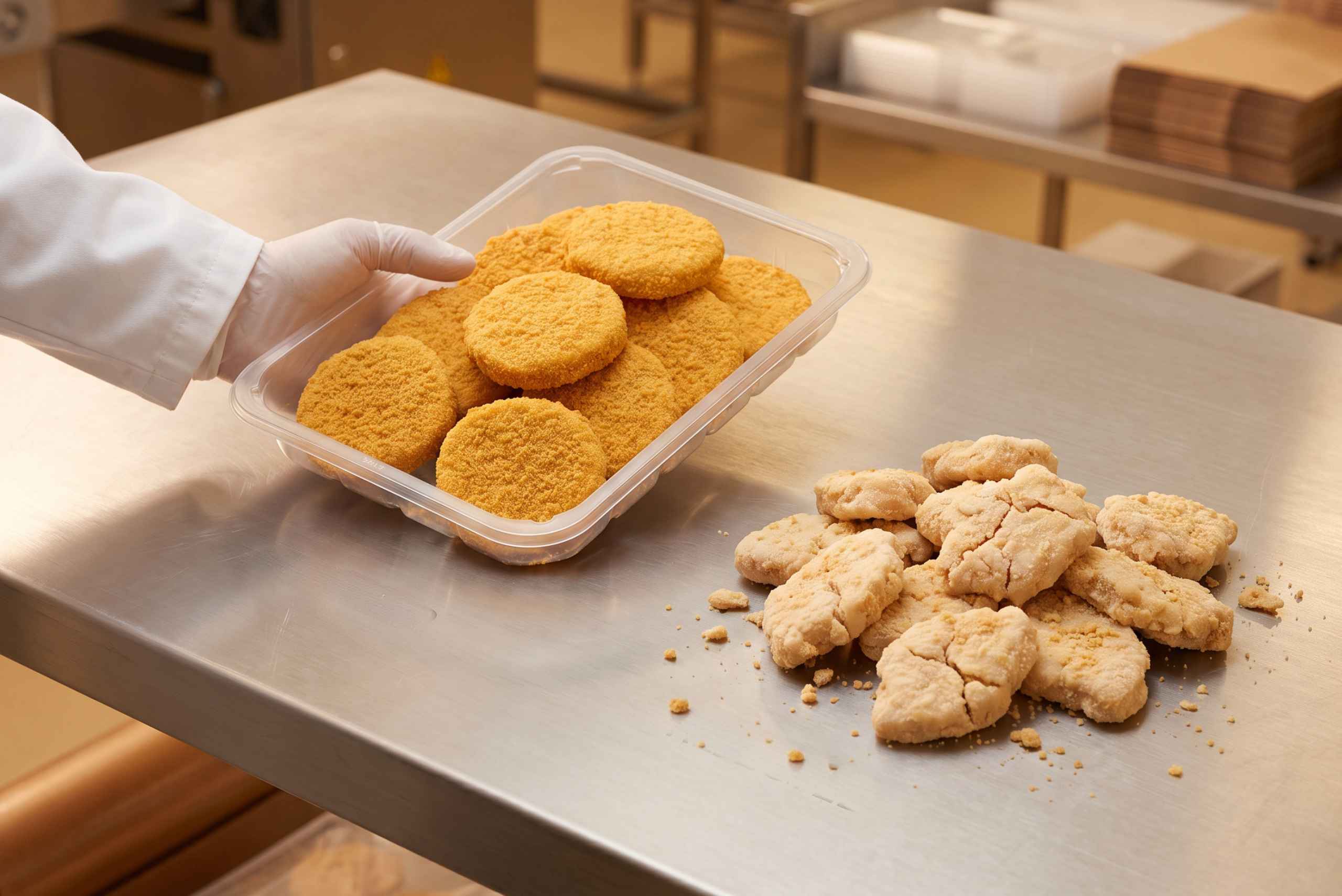
Although this challenge affects multiple stages of production, the breading system is one of the areas where there is still significant room for improvement. This is where the role of a breadcrumbs manufacturer takes on strategic importance.
Food waste is also generated within the production line
When we talk about food waste, we often think of products that are never sold or food discarded by consumers. However, a significant proportion of losses occurs much earlier, during industrial processing itself.
In a breading line, waste can arise for a variety of reasons:
- Uneven coatings that require the product to be reprocessed.
- Breadcrumb loss during transport or frying.
- Excessive coating that increases raw material consumption.
- Rejected batches that fail to meet quality specifications.
- Variations in the weight or final appearance of the product.
Each of these issues leads to greater resource consumption, longer production times and higher operating costs.
The stability of the breading system has a direct impact on industrial performance.
For this reason, a breadcrumbs manufacturer should not only supply a high-quality ingredient, but also develop solutions capable of delivering consistent performance throughout the entire production process.
When breadcrumbs maintain consistent characteristics in terms of particle size, moisture and density, it becomes easier to control variables such as coverage, adhesion and dosing.
This stability helps reduce deviations that can ultimately lead to food waste.
The importance of controlling pick-up in breading performance
One of the most important indicators in any breading line is pick-up, meaning the amount of coating that remains adhered to the food after the application process.
When this parameter is not properly controlled, two undesirable situations can occur.
If the coating is insufficient, the product may show visual defects, loss of texture or fail to meet the specifications agreed with the customer.
Conversely, excessive breadcrumb application increases raw material consumption and raises the cost per unit produced without adding additional value to the product.
Working with a stable breading system makes it possible to optimise pick-up, achieving uniform coverage while reducing both ingredient waste and variations between batches.
Another common source of waste is the loss of coating during the different stages of the industrial process.
When breadcrumbs do not adhere properly to the substrate, part of the coating may be lost during internal handling, freezing, frying or packaging.
In addition to unnecessary raw material consumption, these losses can affect line cleanliness, increase maintenance requirements and have an impact on the quality of the final product.
For this reason, developing solutions that promote stable adhesion is one of the main ways to improve process efficiency.
Reducing rejected batches also reduces food waste
Every rejected batch represents a loss of raw materials, energy, water, production time and industrial capacity.
In many cases, these rejections are related to inconsistencies in the breading system, such as colour differences, uneven coverage or variations in texture.
Although not all of these defects originate from the breadcrumbs themselves, working with a breadcrumbs manufacturer that guarantees a high level of batch-to-batch consistency helps minimise one of the factors that can create variability in the final product.
The more stable the coating system, the lower the risk of deviations during production.
Reducing waste starts with the design of the breading system
Reducing food waste does not depend solely on good operating practices. It also requires reviewing the performance of each component involved in the process.
From particle size and bulk density to flowability and dosing stability, every characteristic of the breadcrumbs influences the efficiency of the production line.
For this reason, the development of new solutions should take into account not only the sensory characteristics of the final product, but also their ability to reduce losses and support a more stable production process.
Industrial sustainability increasingly means producing better while making more efficient use of the same resources.
As a breadcrumbs manufacturer, at Frumen we understand that improving the efficiency of a breading system also means helping our customers reduce waste, minimise rejected batches and optimise the use of raw materials.
We develop solutions tailored to each application with the aim of delivering stable performance throughout the entire production process, helping to improve both the quality of the final product and the profitability of the production line.
Because reducing food waste is not simply about generating less waste.
It is about designing more efficient processes from the very beginning.
Leave A Comment