

Choosing the right breadcrumbs is an important decision in food product development. Although breadcrumbs may seem like a simple ingredient at first glance, their particle size influences the appearance, texture and eating experience of the final product.
A traditional breaded fillet, a croquette with a delicate texture or a meat product with an especially crispy coating do not necessarily require the same type of breadcrumbs. Each preparation has its own characteristics and requires the right balance between coverage, adhesion and sensory performance.
For food manufacturers, ready-meal producers and HORECA professionals, understanding the differences between fine, medium and coarse breadcrumbs helps identify the most suitable option for each application.
What Are the Differences Between Fine, Medium and Coarse Breadcrumbs?
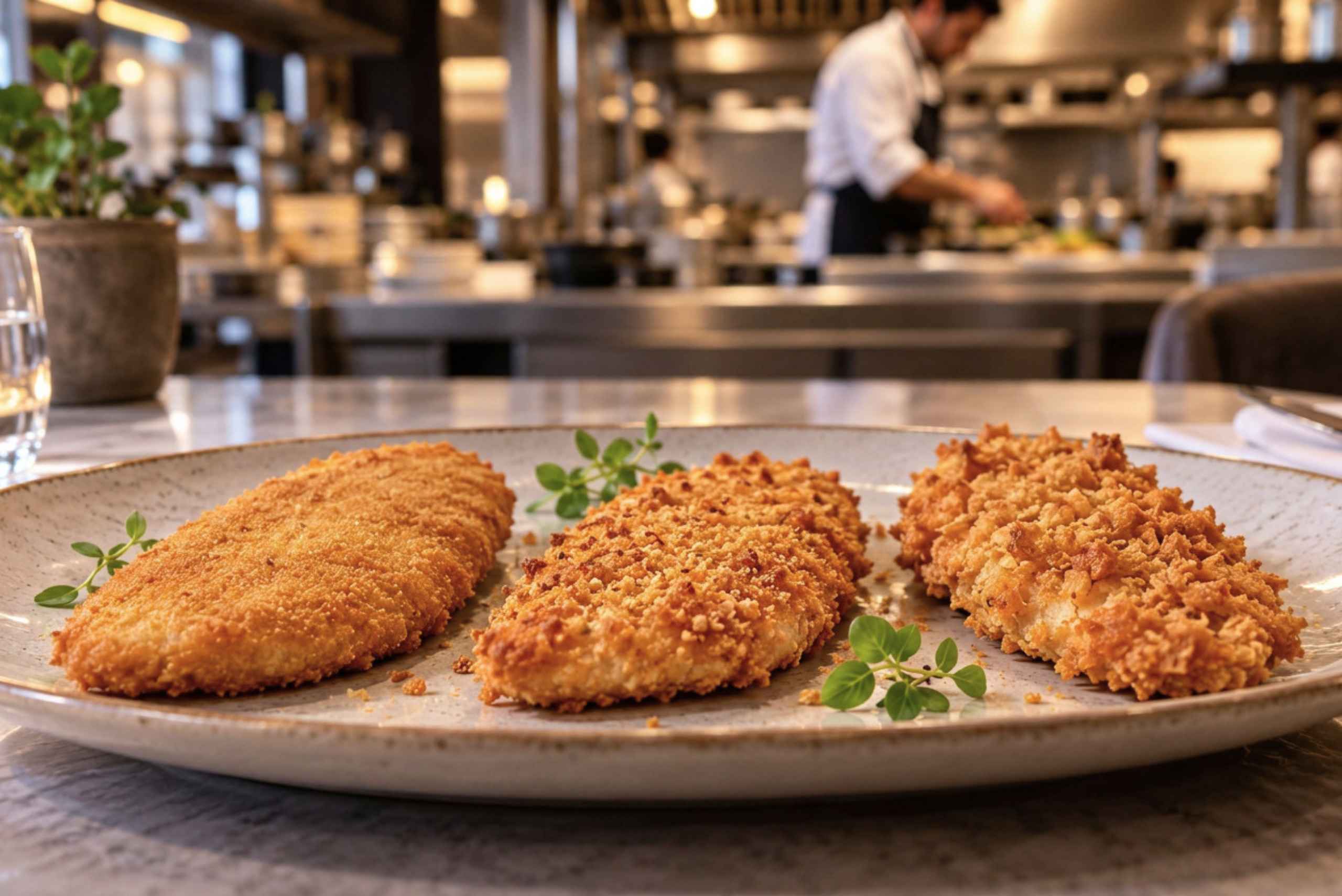
The main difference between these three types is the size of the particles that make up the breadcrumbs. This characteristic, known as particle size or granulation, affects the appearance and texture of the coating.
However, from a food application perspective, what really matters is not simply the particle size, but the result you want to achieve.
- Fine breadcrumbs: Produce smoother, more uniform-looking coatings. They are particularly suitable for delicate preparations or products requiring a subtle finish.
- Medium breadcrumbs: Offer a balance between uniformity and texture. They are a versatile option for many traditional breaded products.
- Coarse breadcrumbs: Provide a more visible coating with a pronounced outer texture. They are suitable for products designed to highlight the crispiness of the coating.
These differences are general guidelines, as the final result also depends on the composition of the breadcrumbs, the characteristics of the food and the preparation method.
Fine Breadcrumbs: Applications Requiring a Delicate Coating
Fine breadcrumbs are characterised by their small particles, which make it possible to achieve visually uniform coatings with a less pronounced outer texture.
They are an interesting option when the aim is for the coating to complement the main ingredient without becoming the dominant feature of the product.
Which Products Are Best Suited to Fine Breadcrumbs?
Potential professional applications include:
- Croquettes with a delicate texture: When a thin coating is required without overshadowing the creamy interior.
- Thin meat or fish fillets: To achieve an even finish that is proportionate to the thickness of the product.
- Plant-based products: For preparations requiring a subtle, visually uniform coating.
- Food mixtures and fillings: When breadcrumbs are incorporated as an ingredient and even distribution is needed, provided the formulation is suitable.
In the latter case, breadcrumbs perform a different function from that of an external coating. The choice should also consider hydration capacity and the final texture of the mixture.
Fine breadcrumbs can be particularly useful for manufacturers prioritising a consistent appearance and a delicate eating experience while maintaining a distinct outer layer.
Medium Breadcrumbs: Versatility for Traditional Breaded Products
Medium breadcrumbs offer a balance between the delicacy of fine particles and the more pronounced texture of coarse breadcrumbs.
Their versatility makes them an interesting option for manufacturers producing different ranges of breaded products that need to maintain a recognisable appearance.
Main Applications of Medium Breadcrumbs
This type can be used in a wide variety of preparations:
- Breaded fillets and escalopes: When a traditional coating with a noticeable texture and uniform finish is required.
- Croquettes and ready-to-cook products: When a balance between an even surface and a crispy exterior is desired.
- Chicken nuggets and other chicken products: To achieve a defined coating without necessarily using large particles.
- Fish products: Particularly in preparations requiring a conventional breaded coating and a balanced sensory result.
One of their main advantages is their ability to adapt to different product profiles.
However, this does not mean that a single type of medium breadcrumbs is suitable for every application. The characteristics of the food, the coating system and the final preparation method remain determining factors.
For manufacturers with extensive product ranges, evaluating medium breadcrumbs as a starting point can help identify which products require a finer or more pronounced texture.
Coarse Breadcrumbs: For Products with a More Pronounced Texture
Coarse breadcrumbs make it possible to develop breaded products with more visible particles and a more textured outer finish.
They are particularly interesting for products where crispiness is part of the value proposition and helps differentiate the food from other alternatives on the market.
Professional Applications of Coarse Breadcrumbs
Suitable applications may include:
- Cachopos and larger meat products: When a substantial coating and a noticeable contrast in textures are desired.
- Chicken or fish fingers: To achieve a more pronounced outer finish.
- Breaded snacks and appetisers: Where the texture of the coating plays a leading role in the eating experience.
- Premium plant-based products: Designed to stand out through a more rustic-looking coating.
In these applications, particle size can help create a specific sensory identity. However, larger particles do not automatically guarantee a crispier product. The structure of the breadcrumbs, their formulation, adhesion and heat treatment also influence the final result.
Therefore, choosing coarse breadcrumbs should respond to a genuine product requirement rather than simply a desire for a more visually striking coating.
How to Choose Breadcrumbs According to the Type of Product
Selecting breadcrumbs should begin by defining the characteristics you want to achieve in the finished food product.
Although every development requires a specific assessment, the following comparison can serve as an initial guide:
| Food product | Suggested starting particle size | Desired finish |
| Croquettes with a delicate texture | Fine | Smooth, subtle coating |
| Thin meat or fish fillets | Fine or medium | Uniform breading |
| Traditional escalopes | Medium | Balance between coverage and texture |
| Chicken nuggets | Medium | Well-defined coating |
| Cachopos | Medium or coarse | More substantial coating |
| Crispy fingers and snacks | Coarse | Pronounced outer texture |
| Breaded plant-based products | Fine, medium or coarse | According to the product’s sensory identity |
| Food mixtures and fillings | Fine, depending on formulation | Even incorporation of the ingredient |
These recommendations should not be interpreted as fixed rules. The same product may use different particle sizes depending on its market positioning, recipe and the eating experience it is intended to deliver.
Five Criteria for Selecting Professional Breadcrumbs
Beyond the differences between fine, medium and coarse particles, there are other factors worth considering before choosing a product for industrial use.
1. The Desired Texture of the Finished Product
The first criterion should be the experience you want to offer consumers.
Are you looking for a fine, subtle coating, traditional breading or an especially crispy exterior?
Defining this characteristic helps narrow down the options and guide product testing.
2. The Characteristics of the Food
The size, shape, surface moisture and consistency of the main ingredient influence the choice.
A delicate piece of fish, for example, may require a different coating from a thicker meat product.
3. The Preparation Method
Not all breaded products are prepared or consumed in the same way.
Deep-frying, oven baking and air frying can produce different results when using the same breadcrumbs.
For this reason, it is important to evaluate the texture, colour and performance of the coating after the intended cooking method.
4. Presentation and Market Positioning
The appearance of the coating also communicates certain product characteristics.
A fine coating may be associated with delicate preparations, while a more visible texture can reinforce the perception of a rustic or especially crispy product.
The choice should be consistent with the target consumer and the product’s positioning in the market.
5. Consistency of Results
In the food industry, achieving a good result during initial testing is not enough.
The breadcrumbs must make it possible to consistently reproduce the expected characteristics of the final product.
Therefore, when evaluating different alternatives, it is advisable to compare samples prepared under equivalent conditions and assess factors such as coating uniformity, adhesion, colour and texture after cooking.
Frumen: Breadcrumb Solutions Tailored to Every Professional Application
At Frumen, we understand that not all food products require the same breadcrumbs.
As manufacturers specialising in solutions for the food industry and the HORECA sector, we work with different particle sizes, textures, colours and formulations to meet each customer’s needs.
Our approach begins with the product being developed and the result it should deliver to consumers.
From traditional breaded products with a uniform finish to preparations requiring a more distinctive outer texture, our team studies the characteristics of each application to identify the most suitable solution.
In addition to particle size, we can adjust other breadcrumb properties, such as colour, degree of toasting and composition, to meet the objectives of each food development project.
Because choosing between fine, medium and coarse breadcrumbs is not simply about selecting a particle size, but about defining the characteristics of the final product.
Do you need to find the right breadcrumbs for a new product or improve the coating of an existing one?
Contact our team and discover our customised industrial breadcrumb solutions.
Leave A Comment