

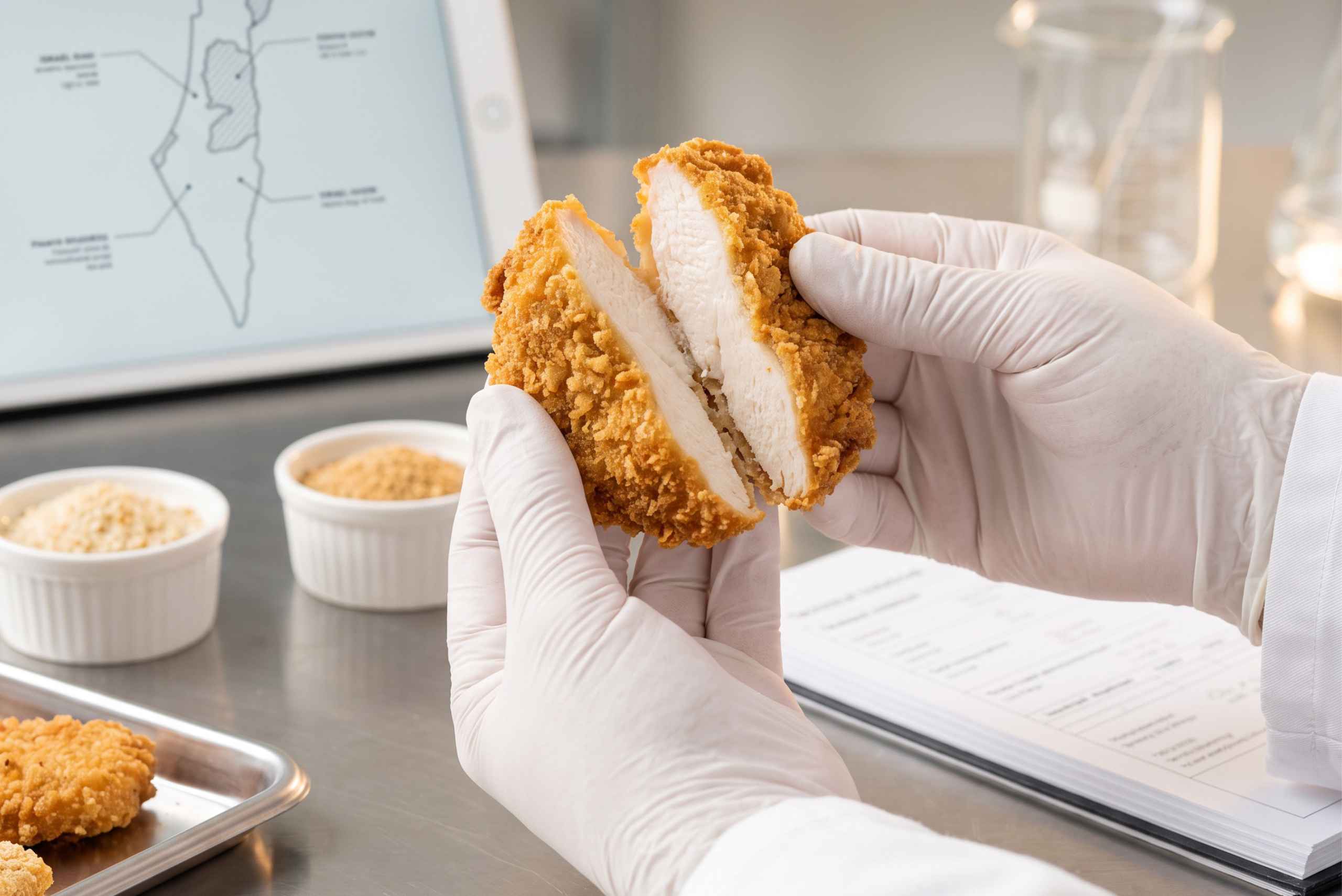
The success of a breaded product does not depend solely on what it contains inside. Before tasting it, the consumer has already received information through its coating: volume, colour, irregularity, particle size and overall appearance all influence the initial perception of the food.
Then comes the bite. And with it, factors such as crispness, lightness, thickness and the contrast between the interior and the coating, which together complete the eating experience.
This sensory dimension opens up a particularly interesting area of development for manufacturers creating products for the Israeli market. Once the certification and marketing requirements applicable to each project have been addressed, another question arises: how can the product be made recognisable and deliver a differentiated experience?
As a breadcrumbs manufacturer, at Frumen we work precisely with these variables. Particle size, colour, degree of toasting, crumb structure and behaviour during preparation make it possible to develop different solutions depending on the product, the process and the result the customer wants to achieve.
Among these, Panko is particularly interesting when the objective is to create a breaded coating with a strong visual and sensory identity.
Panko is characterised by a structure that differs from conventional breadcrumbs. Its flake-like particles create a distinctive visual finish and make it possible to achieve a light, crispy coating.
For this very reason, from an industrial development perspective, choosing Panko means modifying an important part of the food’s outer architecture.
The size and shape of the particles influence how the coating is distributed across the surface. They also affect the product’s visual volume and the sensation it creates when bitten.
Therefore, when a manufacturer is looking to develop a premium product, Panko can be used as a tool to differentiate the final product, provided that the selected solution is compatible with the substrate and actual production conditions.
At Frumen, we offer Japanese-style Panko, characterised by its flake-like finish and designed to achieve an attractive, crispy and light coating. It can be used on a variety of foods, including meat, fish and vegetables, and is available in professional 10 kg and 12 kg formats.
Describing a product as “crispy” is too generic when working in food development. Two coatings can both be crispy while delivering completely different experiences.
A finer particle size may produce a relatively uniform surface, while larger particles can add more texture and alter the bite perception. Panko, due to its own morphology, provides a different finish from conventional breadcrumbs.
The decision should therefore begin with the sensory objective of the finished product.
Before selecting the breadcrumbs, it is advisable to define what we want to achieve:
- A fine coating or one with greater visual presence?
- A regular surface or one that is deliberately more irregular?
- A light bite or a more pronounced crunch?
- What colour should the finished product have?
- How will it be cooked before consumption?
- What behaviour is required after freezing and handling?
These questions turn breadcrumb selection into a development decision rather than simply a purchasing decision.
The same solution will not necessarily deliver the same result on chicken, fish, cheese or a plant-based alternative.
Surface characteristics vary. So do moisture levels, food structure and processing conditions.
This difference is crucial when using the coating to position a product as premium.
Panko for chicken and other meats
In chicken pieces and meat products, a visually differentiated structure can help create a distinctive identity.
However, the result does not depend solely on the Panko. The relationship between the substrate, the adhesion layer and the coating must allow the particles to remain properly attached throughout the intended process.
Panko for fish
With fish, the surface characteristics and moisture of the food also require the entire system to be studied.
Once again, it is important to avoid selecting breadcrumbs based solely on how they look in dry form. What matters is how they perform once applied to the actual product.
Panko for vegetables and plant-based alternatives
Plant-based applications offer even more opportunities for differentiation.
Fingers, vegetable pieces and meat alternatives can benefit from Panko’s structure to create a coating with greater visual and sensory personality.
However, different plant-based substrates can behave very differently. Therefore, the solution must be specifically validated for each formulation.
Particle size, colour and toasting: three tools for differentiating a breaded product
The work of a breadcrumbs manufacturer does not end with choosing between conventional crumb and Panko. Within the same concept, different characteristics can be adjusted to move closer to the desired result.
Particle size
Particle size distribution influences coverage, appearance and texture.
For this reason, defining the right particle size requires the food and the industrial process to be assessed together.
Colour
The colour of the coating directly influences the visual perception of the product.
It should not be evaluated only on the ingredient before cooking. What matters is determining how the product will look after the intended heat treatment.
Degree of toasting
Toasting makes it possible to adjust both the appearance and the sensory characteristics of the breadcrumbs.
At Frumen, we can adapt industrial solutions in variables such as ingredients, colour, particle size and degree of toasting, all of which already form part of our development capabilities for international projects.
Combining these variables makes it possible to move from selecting a standard reference to developing a solution aligned with a specific objective.
Developing differentiated and efficient breaded products on an industrial scale
There is a risk when it comes to differentiation: developing a product that is sensorially attractive but difficult to manufacture at scale.
For an industrial customer, a premium solution only makes sense if it can be transferred to production with sufficient stability.
The coating must be analysed taking into account variables such as adhesion, the required percentage of coverage, behaviour during freezing, resistance to handling and the subsequent preparation method.
It must also provide adequate consistency from batch to batch.
For this reason, differentiation and industrial performance must be developed together.
The goal is not to achieve an exceptional laboratory sample. It is to create a differentiated product that can be reproduced in line with the manufacturer’s requirements.
From visual appearance to the complete product experience
One of the advantages of working on the coating from the earliest stages of the project is that it allows different moments of the eating experience to be designed together.
- First comes appearance. The consumer sees the colour, texture and coverage.
- Then comes the exterior texture during the bite.
- Finally, there is the contrast between the coating and the inside of the food.
Panko is particularly effective for working on this outer dimension thanks to its characteristic structure, but it must be properly integrated into the overall system.
For an industrial manufacturer, this means that breadcrumbs can become a positioning variable, in addition to fulfilling their technical function.
A nugget, a plant-based finger, a portion of fish or a piece of chicken can take on a different identity by changing its coating system, without differentiation having to depend exclusively on the filling.
At Frumen, we develop breadcrumbs, Panko and customised solutions for food manufacturers.
For projects aimed at the Israeli market, we can assess the product from two dimensions that must be compatible: the requirements applicable to the project and the technical and sensory performance required by the customer.
Kosher certification, when necessary, should be addressed from the outset and verified for the specific product reference and project. Using a certified ingredient does not in itself guarantee certification of the finished product.
The differentiation of a breaded product can begin at its surface.
A coating with a recognisable structure, a particle size selected for the application and a visual result that is consistent with the product’s positioning can help create a distinctive experience.
Panko is one of the most interesting possibilities, but it is not the only one.
As a breadcrumbs manufacturer, our job is to understand what the customer wants to achieve and assess which solution can best meet the needs of their product and process.
Because developing a premium product does not simply mean adding a different ingredient. It means turning texture, appearance and industrial performance into a reproducible product proposition.
If you are developing a breaded product for the Israeli market, contact us. We will be happy to discuss your project with you.
Leave A Comment