

In the food industry, breadcrumbs are often evaluated according to characteristics such as color, particle size, or the sensory result they deliver in the final product. However, there is another aspect that is equally important and far less visible: how breadcrumbs behave inside the production line.
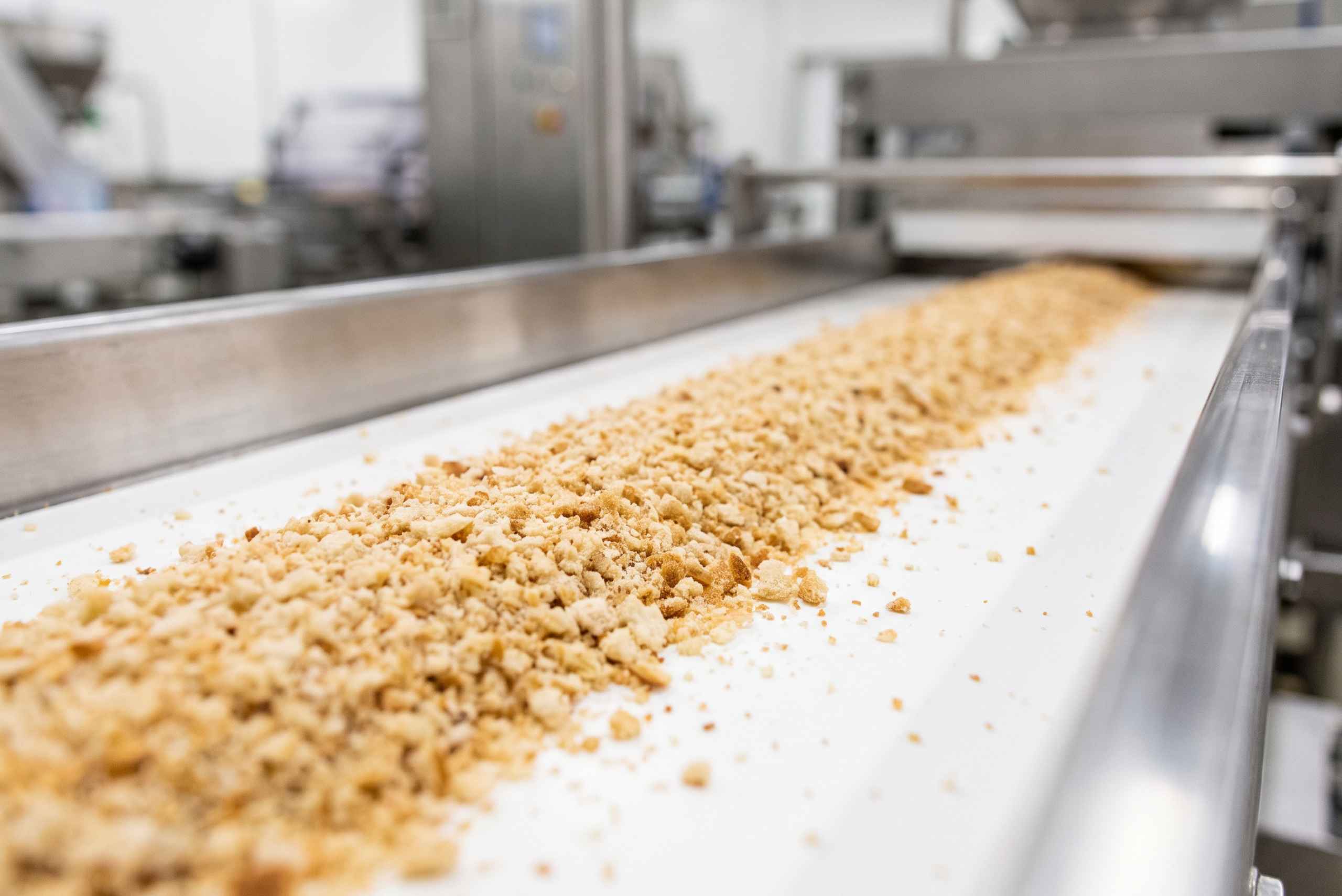
Before becoming the coating on a nugget, croquette, or breaded fillet, breadcrumbs must pass through hoppers, screw conveyors, belts, elevators, and automatic dosing systems. During this journey, properties such as flowability, bulk density, moisture, and particle-size distribution can influence process stability and, as a result, the efficiency of the entire plant.
For this reason, in an industrial environment where every minute of production matters, breadcrumbs should not be understood only as an ingredient, but as a material that must behave predictably throughout every stage of the process.
Breadcrumb behavior also determines line efficiency
Consistency is essential in an automated production line. Equipment is designed to operate with stable parameters, and any variation in breadcrumb behavior can create deviations that affect both productivity and final product quality.
When breadcrumb flow becomes irregular, problems can arise such as interruptions in machine feeding, differences in product coverage, or inconsistent raw material consumption. These issues are not always immediately visible, but they can eventually affect productivity and manufacturing costs.
For this reason, more and more manufacturers consider the physical behavior of breadcrumbs to be a technical criterion that is just as important as their sensory properties.
Breadcrumb particle size and its influence on automated conveying
Particle size distribution is one of the factors that most strongly affects breadcrumb behavior during handling.
Breadcrumbs with a uniform particle-size distribution generally promote a more stable flow through hoppers and feeding systems. By contrast, when particles of very different sizes are present together, the likelihood of segregation during transport increases.
This separation changes the composition of the mixture and can mean that the particle distribution reaching the product is different from the one originally formulated. The result may be an uneven finish and texture differences between production batches.
For this reason, particle-size control affects not only consumer perception, but also the stability of the industrial process.
Another key factor is the presence of fine particles.
Fines play an important role within a coating system, but when their proportion is too high, they can alter breadcrumb flowability and promote compaction during storage or while moving through hoppers.
This can result in irregular equipment feeding, making it more difficult for automatic systems to maintain consistent dosing.
Excessive fines can also increase product losses and affect coating uniformity, especially on high-speed lines. For this reason, controlling the proportion of fine particles is part of the technical design of breadcrumbs, not just their visual appearance.
Breadcrumb moisture influences process stability
Moisture is another critical variable for ensuring stable behavior.
Small variations can change the physical properties of breadcrumbs and affect their ability to move consistently through conveying equipment.
A moisture content above the expected level can encourage agglomeration and make hopper discharge more difficult. By contrast, an excessively dry product can increase dust generation and change dosing behavior.
Maintaining the right balance is essential to ensure that breadcrumbs preserve consistent properties from manufacturing through to application on the food product.
In many industrial processes, breadcrumbs are dosed volumetrically. This means that the amount applied depends directly on the relationship between volume and density.
If bulk density varies between batches, the actual amount of breadcrumbs received by each piece may also vary, even when the dosing system remains at the same setting.
This can result in differences in coverage, higher raw material consumption, or variation in final product weight.
For this reason, density stability is one of the parameters that contributes most to repeatable production.
Breadcrumb segregation: a silent phenomenon with a major impact
One of the least visible problems in automated lines is segregation.
During transport or hopper filling, particles may redistribute according to size, shape, or density. As a result, the mixture loses homogeneity and the breadcrumbs no longer behave consistently.
Although this phenomenon may go unnoticed during production, its effects can become visible in the final product:
- Differences in coating appearance.
- Variations in texture.
- Uneven coverage.
- Greater variability between batches.
Reducing segregation requires appropriate design both of the breadcrumbs themselves and of the handling system used in the plant.
In industrial applications, the success of breadcrumbs does not depend only on how they perform during frying or baking.
They must also behave consistently throughout all previous stages:
- Storage.
- Pneumatic or mechanical conveying.
- Hopper feeding.
- Automatic dosing.
- Recirculation of excess material.
Each of these stages can influence overall process efficiency and should therefore be considered during product development.
For this reason, designing industrial breadcrumbs requires analyzing both how they perform on the food product and how they behave inside the production line.
Breadcrumbs as part of industrial efficiency
In a context where automation and cost optimization are priorities, the physical behavior of breadcrumbs is becoming increasingly relevant.
Particle size, density, moisture, and resistance to segregation are no longer just technical specifications. They become variables that directly affect productivity, repeatability, and raw material utilization.
For this reason, companies seeking to improve process efficiency increasingly value solutions developed with not only the final coating result in mind, but also the behavior of breadcrumbs throughout the entire production line.
At Frumen, we know that in the food industry, the quality of a breaded product begins long before it reaches the fryer or oven.
The ability of breadcrumbs to flow consistently, maintain mixture homogeneity, and be dosed accurately has a direct influence on process stability and production efficiency.
That is why breadcrumb development is no longer limited to achieving an attractive visual finish or a crispy texture. It also means designing products that perform reliably under the demands of automated production lines, helping manufacturers produce more efficiently, consistently, and profitably.
Leave A Comment