

The plant-based food market continues to grow at a steady pace. According to market forecasts, the global plant-based food market reached USD 50.7 billion in 2025 and is expected to surpass USD 111 billion by 2035, driven by a compound annual growth rate (CAGR) of 8.16%.
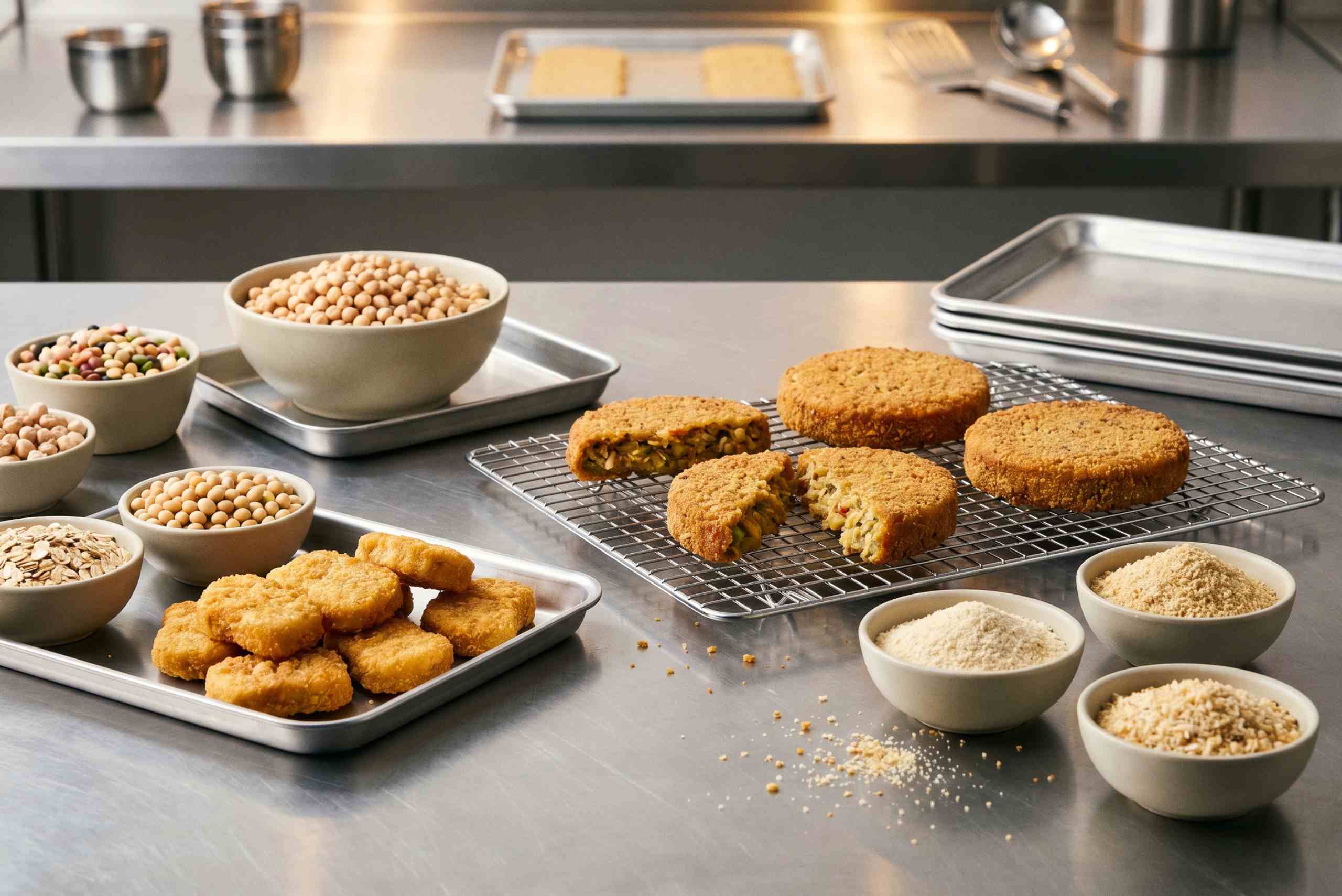
Within this expanding market, one of the most promising segments is breaded plant-based products. Soy nuggets, cauliflower fingers, lentil burgers, and croquettes made from pea protein are all part of a category that is gaining ground in both foodservice and retail.
However, behind every successful product lies a technical challenge that often goes unnoticed: ensuring that breadcrumbs deliver the same performance on a plant-based substrate as they do on animal-based products.
Why Do Breadcrumbs Perform Differently on Plant-Based Protein?
From an industrial perspective, coating animal proteins is a relatively stable process. However, when working with plant-based substrates, new variables emerge that directly affect breadcrumb performance.
Plant proteins generally have less uniform surfaces and a lower natural capacity to retain moisture, making it more difficult for the coating to adhere properly. As a result, the risk of coating loss during freezing, frying, or baking increases.
In addition, manufacturers must consider several other factors that influence breadcrumb performance in plant-based food development:
- Water and oil retention capacity.
- Formation of stable gels and structures.
- Emulsification of the different phases within the formulation.
- Thermal behavior during cooking, frying, baking, or extrusion.
Each of these factors has a direct impact on the final product, making it essential to adapt the coating system to the specific characteristics of the plant-based substrate.
What Should High-Quality Breadcrumbs Deliver in Plant-Based Products?
When working with plant-based protein, breadcrumbs are no longer a standard ingredient—they become a key technical component of product development.
Their formulation must meet several industrial requirements.
Particle Size Tailored to Each Application
Not every product requires the same coating finish.
A plant-based nugget, a vegetable croquette, and a vegetable finger all have different surfaces and textures. For this reason, breadcrumb particle size must be adapted to achieve uniform coverage while minimizing coating loss during production.
Lower Oil Absorption and Greater Stability
Breadcrumbs also play a crucial role in product performance during frying.
The right combination of cereals and starches makes it possible to develop a coating that can:
- Maintain a crispy texture.
- Reduce oil absorption.
- Improve stability after freezing and reheating.
- Ensure better coating adhesion throughout the production process.
These properties are especially important in a market where consumers are looking for lighter products without compromising on texture and eating experience.
Breadcrumbs Compatible with Clean Label Formulations
Consumers of plant-based foods often pay close attention to ingredient lists.
As a result, the development of new breadcrumb solutions is increasingly focused on formulations that include:
- Plant-based ingredients.
- Gluten-free alternatives.
- Lower fat content through reduced oil absorption.
- Ingredients that help maintain product stability without affecting sensory quality.
Frumen Breadcrumb Solutions for Breaded Plant-Based Products
At Frumen, we develop breadcrumb solutions specifically designed for manufacturers working with plant-based proteins and other plant-based applications.
Our product range includes:
- Panko, ideal for vegetable fingers and larger pieces thanks to its light texture and exceptional crispiness.
- Crujiente, designed to deliver consistent, stable coatings for nuggets, medallions, and other plant-based products after frying or baking.
- Airfryer Oven, a solution developed for products requiring lower oil absorption and a formulation aligned with clean label trends.
In addition, we develop customized breadcrumb solutions tailored to each substrate, manufacturing process, and customer’s specific objectives.
The Future of Breadcrumbs Lies in Specialization
The continued growth of the plant-based market presents new technical challenges for the food industry—but it also creates significant opportunities for innovation.
Breadcrumbs have become a critical element in delivering the texture, stability, and sensory experience that today’s consumers expect. As a result, manufacturers increasingly require specialized solutions capable of adapting to different plant proteins, production processes, and evolving market trends.
At Frumen, we are committed to developing breadcrumb solutions that meet these challenges, helping our customers create breaded plant-based products with outstanding industrial performance and a distinctive consumer experience.
Leave A Comment