

The stability of a frozen breaded product does not depend solely on keeping it at a low temperature. It also depends on how the product is frozen, the temperature fluctuations it experiences during storage and transportation, and how the coating system responds to these changes.
A cold chain disruption does not always mean that the product completely thaws. In many cases, partial temperature increases and decreases can cause water to melt and subsequently recrystallize. Although these changes may not be visible through the packaging, they can alter the internal structure of the food and weaken the bond between the substrate, binder, and breadcrumbs.
For companies developing nuggets, breaded fish, meat products, cheese, vegetables, or frozen snacks, working with a breadcrumb manufacturer capable of analyzing these conditions can help prevent coating loss, cracking, loss of crispiness, and color inconsistencies in the final product.
Thermal cycles in breaded products
Freezing is an effective method for extending food shelf life. Problems can arise when the product undergoes repeated temperature variations during storage, order preparation, loading, transportation, or distribution.
In the European Union, quick-frozen foods must be maintained at a temperature of –18°C or lower in all parts of the product, although brief and limited fluctuations are permitted during transportation. Temperature stability is important not only from a regulatory perspective, but also to preserve the physical characteristics of the product.
A temperature fluctuation does not have to cause complete thawing to affect product quality. When the temperature rises, some of the smaller ice crystals may begin to melt. If the product is subsequently cooled again, the released water can accumulate on other crystals, causing them to grow.
This phenomenon is known as recrystallization.
Larger crystals exert greater pressure on the cells and internal structures of food than the smaller crystals generated during rapid freezing. Studies on meat and aquatic products have linked repeated freeze-thaw cycles to microstructural damage, water migration, and reduced moisture retention capacity.
In a breaded product, these changes do not only affect the interior. They can also alter the surface to which the coating must remain attached.
What happens inside the product during cold chain fluctuations?
A breaded product is a system composed of materials with different compositions and behaviors.
Its structure may include:
- A meat, fish, cheese, or plant-based substrate.
- An initial predust layer.
- A batter or binder.
- An outer breadcrumb coating.
- Seasonings, spices, or inclusions.
- Water distributed across the different layers.
Each of these elements responds differently to temperature changes.
Several phenomena can occur simultaneously during thermal fluctuations.
Formation and growth of ice crystals
The water contained in the product forms crystals during freezing. Their size and distribution depend on factors such as the initial freezing rate, the composition of the food, and subsequent temperature stability.
Rapid freezing generally produces smaller, more evenly distributed crystals. In contrast, slow freezing and subsequent temperature fluctuations can encourage the formation or growth of larger crystals.
Research on frozen meat shows that faster initial freezing can reduce water migration, protein denaturation, and thawing losses compared with slower freezing processes.
Damage to the substrate structure
As ice crystals increase in size, they can alter muscle fibers or the structure of a plant-based matrix.
As a result, the product may lose some of its water-holding capacity. During partial or complete thawing, exudate can be released and migrate towards the surface.
Repeated cycles have been associated with:
- Greater water loss during thawing.
- Reduced water-holding capacity.
- Changes in texture.
- Protein and fat oxidation.
- Color alterations.
- Increased cooking losses.
These effects have been observed in studies involving chicken, beef, pork, and fish products.
Water migration towards the coating interface
Water does not necessarily remain in the same location it occupied before freezing.
When the internal structure of the product deteriorates, some moisture can migrate towards the surface. There, it comes into contact with the predust, batter, and breadcrumbs.
This migration is particularly relevant because adhesion between layers depends on maintaining an appropriate moisture balance.
A surface that is too dry can make initial coating adhesion more difficult. However, excessive water can also dilute or weaken the adhesive layer and create areas with inconsistent performance.
Why can the coating separate?
Coating loss is not always caused by unsuitable breadcrumbs. It may result from an inadequate interaction between the formulation, production process, and storage conditions.
During a cold chain fluctuation, water released by the substrate may accumulate at the interface with the coating. This moisture can alter the consistency of the batter and reduce the strength of the bond.
When the product freezes again, water at the interface also forms crystals. Their expansion and subsequent melting can create small gaps, cracks, or weak points between the layers.
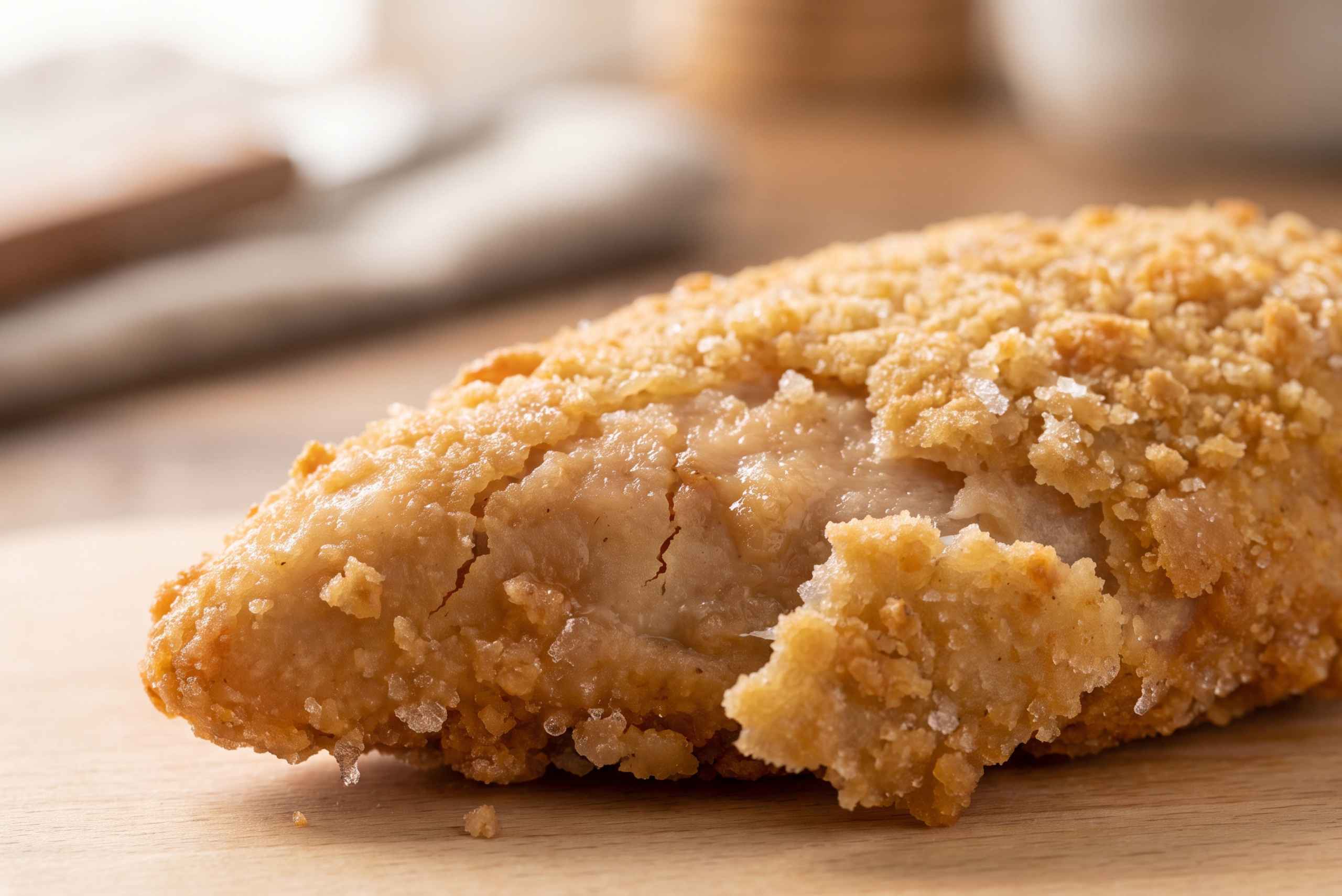
During handling or cooking, these defects may become visible as:
- Loss of breadcrumb particles.
- Separation of entire sections of coating.
- Air pockets beneath the coating.
- Visible cracks.
- Uneven coverage.
- Uncoated areas.
- Accumulation of loose coating in the packaging or fryer.
The problem may become more evident during frying or baking. Retained water turns into steam and increases internal pressure. If the adhesive layer has already been weakened, this pressure can contribute to coating separation.
For this reason, an industrial breadcrumb manufacturer should not focus exclusively on the final texture of the crumb. It should also understand the behavior of the complete system: predust, batter, breadcrumbs, substrate, freezing process, and final cooking method.
How cracks form in breaded products
The different layers of a breaded product do not expand and contract in exactly the same way.
The substrate contains a high proportion of water, while the outer coating is initially drier. As temperatures change, both components respond at different rates.
This difference can generate mechanical stress.
Cracks are more likely to appear when several factors occur simultaneously:
- An excessively rigid breadcrumb layer.
- A substrate that releases large amounts of water.
- An excessively thick coating.
- Uneven batter distribution.
- Sudden temperature changes.
- Mechanical handling of the frozen product.
- Impacts or vibrations during transportation.
- Uneven freezing between the center and surface of the product.
A small crack can become an entry point for moisture. During a subsequent cycle, that moisture may freeze and increase the damage.
This means that defects do not necessarily develop in a linear manner. Several relatively minor fluctuations can lead to cumulative deterioration.
Loss of crispiness due to moisture migration
Crispiness depends on the coating maintaining a dry, rigid, and porous structure after cooking.
When moisture migrates from the interior towards the coating, it acts as a plasticizer. This reduces structural rigidity and can result in a softer or chewier texture.
Studies on fried coatings show that moisture directly affects their mechanical transitions and textural stability. As water content increases, the coating becomes less capable of maintaining the brittle, crispy structure expected by consumers.
In a product exposed to thermal fluctuations, loss of crispiness can occur in two ways:
- Before cooking: breadcrumbs absorb some of the water released by the substrate.
- After cooking: uneven moisture distribution prevents the entire surface from dehydrating consistently.
The result can be a product with both crispy and soft areas, even when it has been prepared using the same time and temperature.
Color differences can originate both inside the product and within the coating itself.
Freeze-thaw cycles can affect the color stability of meat and fish through changes in structure, water distribution, and oxidation processes. Studies involving chicken breast have found that repeated cycles can produce changes in lightness, red and yellow tones, and overall color stability.
Moisture migration can also cause uneven browning in the coating.
A wetter area requires more energy to evaporate the water before reaching the conditions needed for browning. As a result, it may remain lighter or cook differently from a drier area.
Potential effects include:
- Pale areas.
- Dark spots.
- Differences between the center and edges.
- Uneven browning.
- Color variations between batches.
- Areas with greater oil absorption.
Batter formulation, breadcrumb type, and cooking conditions all influence the color and texture of the finished product.
Industrial signs of potential thermal instability
Damage caused by temperature fluctuations cannot always be attributed through visual inspection alone. However, there are several indicators worth investigating.
| Observed sign | Potential related mechanism |
| Loose breadcrumbs in the packaging | Weakened adhesion or mechanical damage |
| Sections of coating separating | Moisture at the interface and ice crystal formation |
| Surface cracks | Differences in expansion and contraction |
| Soft areas after cooking | Moisture migration towards the coating |
| Uneven color | Irregular distribution of moisture and heat |
| Visible exudate | Reduced water-holding capacity of the substrate |
| Increased oil absorption | Damaged or uneven surface structure |
| Weight variations after cooking | Changes in water retention and release |
| Differences between boxes from the same batch | Uneven thermal exposure during storage or transportation |
These signs do not prove on their own that a cold chain disruption has occurred. They should be assessed alongside temperature records, production controls, and historical product performance.
A supplier cannot control the cold chain by itself, nor can it compensate for every possible logistical deviation. However, it can help develop a coating that is better suited to the expected production, storage, and preparation conditions.
A specialized breadcrumb manufacturer can collaborate on:
- Selecting the appropriate particle size.
- Adjusting absorption capacity.
- Improving compatibility with the batter.
- Analyzing the balance between coverage and flexibility.
- Reducing coating loss.
- Studying performance after freezing.
- Adapting color and browning.
- Conducting comparative sample tests.
- Evaluating the coating system according to the final cooking method.
At Frumen, we develop industrial solutions by adapting ingredients, colors, particle sizes, and browning levels. We also consider whether the product will be quick-frozen, processed, or pre-cooked when developing a solution for a specific application.
This is relevant because stability does not depend on a single characteristic. A coarse crumb can provide a highly visible and crispy finish, but it also requires sufficient adhesion. A finer coating may provide more uniform coverage, although its behavior in the presence of moisture will be different.
The objective is to find the right balance between appearance, texture, adhesion, and resistance to production and distribution conditions.
How to reduce the effects of thermal fluctuations
There is no single measure capable of preventing every problem. An industrial strategy can, however, combine several actions:
- Design the coating system for the specific substrate.
- Control surface moisture before applying the predust.
- Maintain stable batter viscosity.
- Avoid excessive time between coating and freezing.
- Ensure rapid and uniform freezing.
- Verify core temperature.
- Minimize time outside cold storage.
- Review critical loading and unloading points.
- Use temperature data loggers when necessary.
- Validate the product through controlled thermal testing.
- Compare the performance of different breadcrumb particle sizes.
- Train production and logistics teams.
Prevention should begin during product development, before the product reaches full-scale industrial production.
If your product loses coating or crispiness after freezing, you can request a technical consultation with Frumen. Our team can help assess the application and identify the most suitable industrial breadcrumb solution.
Frequently Asked Questions
They can promote the formation of larger ice crystals, water migration, and weakening of the bond between the food substrate and its coating. This may result in cracks, coating loss, soft areas, and color inconsistencies.
Does a product have to thaw completely to suffer damage?
No. Partial temperature fluctuations can cause ice to melt and recrystallize even when the product still appears to be frozen.
Why does a frozen breaded product lose its crispiness?
One possible cause is moisture migration from the substrate towards the coating. Water reduces coating rigidity and makes it more difficult to achieve a uniformly dry and crispy texture during cooking.
No. It can also be related to product moisture, predust application, batter viscosity, freezing rate, handling, or cold chain fluctuations.
In addition to an appropriate particle size, a breadcrumb manufacturer should be able to assess absorption, adhesion, color, browning, and coating performance under real production, freezing, and cooking conditions.
How can the stability of a breaded product be tested?
Through comparative tests evaluating coating loss, water loss, texture, color, pick-up, and performance after controlled thermal cycles.
Leave A Comment