

In the food industry, choosing industrial breadcrumbs is not simply a matter of selecting an ingredient with a specific colour, texture or format.
When we talk about breaded products on an industrial scale, breadcrumbs form part of a much broader system involving multiple variables: the type of food, the application process, the technology used, the cooking method and the sensory expectations of the end consumer.
That is why, before approving a product reference or starting a new development, it is essential to define correctly the characteristics that the breadcrumbs must meet for a specific application.
A technical data sheet should not be understood merely as a quality document or purchasing tool. In reality, it is a key element for aligning the needs of different departments:
- R&D needs to understand how the product will perform in the application.
- Production needs to ensure process stability.
- Quality must ensure compliance with specifications.
- Purchasing needs to compare solutions and suppliers.
In a market where breaded products are becoming increasingly varied and specialised, correctly defining the technical specifications of industrial breadcrumbs is an essential step in achieving consistent results.
Industrial Breadcrumbs Should Be Defined According to the Final Application
There is no single type of industrial breadcrumb suitable for every application. A manufacturer’s requirements can change completely depending on the product being developed.
Breadcrumbs intended for an industrial croquette will not necessarily have the same requirements as those used for a frozen fish product, a plant-based nugget or a premium preparation.
Each application presents different challenges:
- Desired level of coverage.
- Target final texture.
- Cooking system.
- Storage time.
- Regeneration method.
- Production speed.
- Type of industrial line.
For this reason, the development of industrial breadcrumbs should always begin with one fundamental question:
What result does the final product need to achieve?
Based on that answer, the necessary technical parameters can be defined so that the coating performs correctly.
What Should an Industrial Breadcrumb Technical Data Sheet Include?
A useful technical data sheet should include the parameters that make it possible to anticipate product behaviour throughout the entire manufacturing process.
Although each application may require different specifications, there are several fundamental variables that should be analysed.
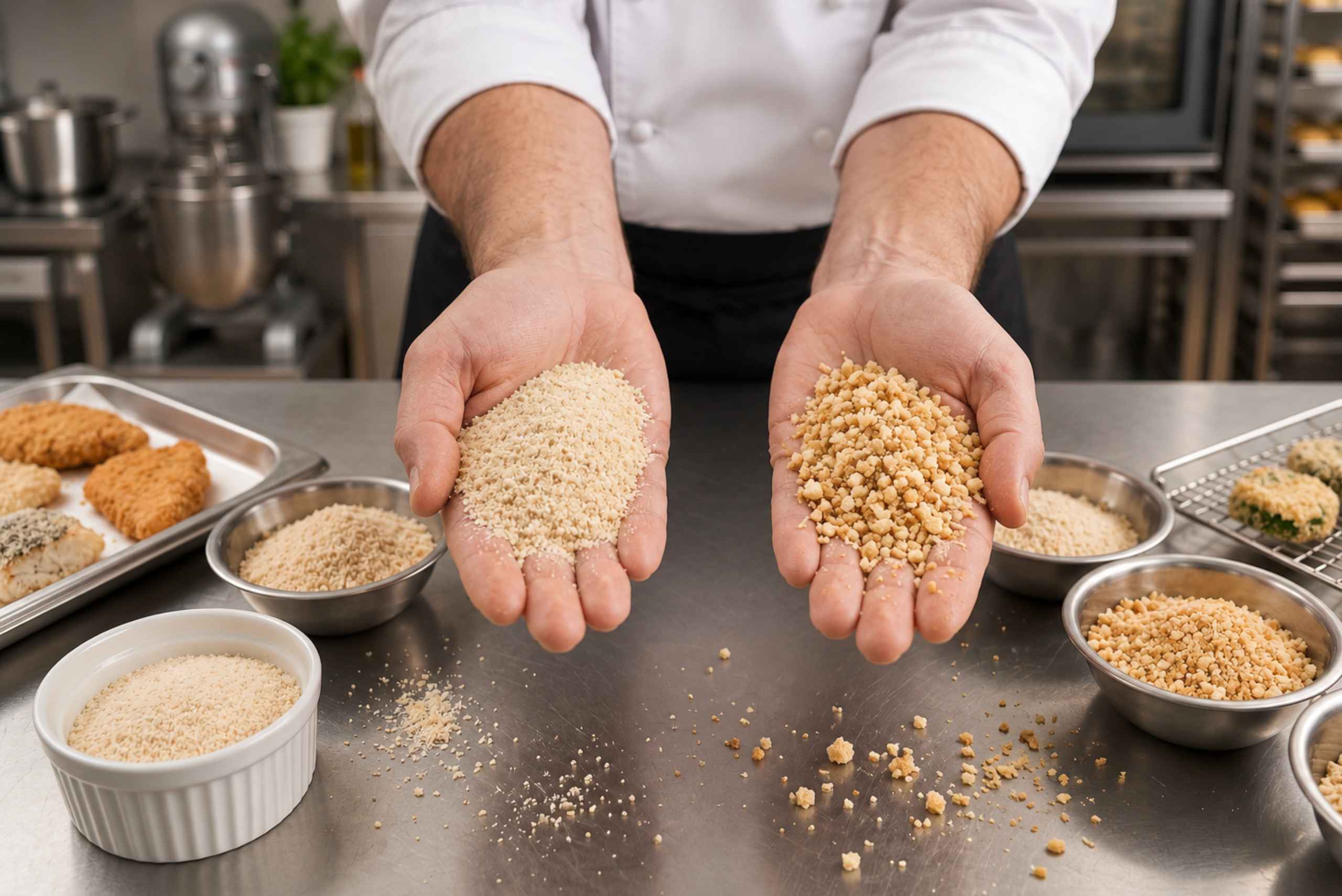
Breadcrumb Particle Size: The Basis of Coating Performance
Particle size is one of the most important parameters of any industrial breadcrumb.
It refers to the distribution and size of the particles that make up the product and has a direct influence on aspects such as:
- Food coverage.
- External appearance.
- Final texture.
- Perceived crispiness.
- Coating adhesion.
Breadcrumbs with smaller particles can promote a more uniform coating, while larger particles can provide a more visible finish and a distinctive texture.
For example, a product designed to achieve a more artisanal or premium appearance may require a different particle structure from an application where coating uniformity is the main priority.
In addition, particle-size distribution should remain stable from batch to batch to ensure that the final product consistently maintains the same characteristics.
Particle size should therefore not be considered merely a physical specification, but rather a tool for designing the final product.
Breadcrumb Moisture: A Key Parameter for Industrial Stability
Moisture is another fundamental variable within technical specifications.
Although it may primarily be associated with product preservation, its influence goes much further.
Moisture levels can affect:
- Breadcrumb flowability.
- Generation of fines.
- Ease of transport within the production facility.
- Storage stability.
- Behaviour during application.
Excess moisture can encourage compaction or the formation of agglomerates, while a product that is too dry may increase dust generation and alter its behaviour at certain stages of the process.
For this reason, maintaining controlled moisture levels helps ensure that industrial breadcrumbs retain consistent properties from manufacture through to application.
Colour and Toasting: Controlling the Appearance of the Final Product
In breaded products, visual appearance has a major influence on consumer perception.
The colour of the breadcrumbs can determine whether a product is perceived as:
- More artisanal.
- More premium.
- Lighter.
- More traditional.
However, in industrial applications, achieving an attractive colour is not enough.
Batch-to-batch repeatability must also be guaranteed.
Variations in toasting level or breadcrumb shade can create visible differences between products manufactured in different production runs or at different facilities.
For this reason, colour control forms part of the technical specification that helps ensure consistency in the final product.
Bulk Density: An Important Variable for Dosing
Bulk density is a particularly relevant parameter in industrial processes where breadcrumbs are dosed using automated systems.
This property relates the quantity of product present within a given volume and can directly influence the amount applied to the food.
If density changes between batches, even when the dosing system maintains the same settings, the actual amount of product applied may vary.
This can affect:
- Final product weight.
- Raw material consumption.
- Coverage achieved.
- Process efficiency.
For this reason, controlling bulk density helps improve production repeatability and stability.
Oil Absorption and Behaviour During Cooking
The final result of a breaded product does not depend solely on its appearance before cooking.
The behaviour of the breadcrumbs during frying, baking or other preparation methods is crucial to the consumer experience.
Some of the factors that should be considered include:
- Ability to develop a crispy texture.
- Control of oil absorption.
- Coating stability.
- Retention of texture after preparation.
Properly developed industrial breadcrumbs should perform according to the intended cooking method and maintain the desired characteristics until the moment of consumption.
For this reason, coating selection should take the product’s entire journey into account, not only its initial application.
Food Safety and Technical Documentation
In addition to physical and functional characteristics, a technical data sheet should include the information required to guarantee product safety and traceability.
Common aspects include:
- Specifications agreed with the customer.
- Ingredient information.
- Applicable legal requirements.
- Microbiological parameters.
- Traceability systems.
- Certifications or specific market requirements.
In industrial applications, this documentation is an essential part of the supplier approval and product development process.
A Good Technical Specification Facilitates New Product Development
When a manufacturer is working on a new breaded product, correctly defining the characteristics of the breadcrumbs from the outset can reduce subsequent adjustments and accelerate industrialisation.
Before developing a solution, it is important to analyse:
- Which food product will be coated.
- Which texture is required.
- How the coating will be applied.
- Which thermal process it will undergo.
- What shelf life is required.
- What requirements the end consumer will have.
This information makes it possible to select the appropriate technical variables and develop a solution that is better adapted to real production conditions.
Industrial Breadcrumb Development Requires a Global Technical Perspective
In industrial applications, the success of breadcrumbs does not depend on a single parameter.
Particle size, moisture, colour, density and absorption are variables that should be understood as part of a complete system.
A suitable solution must respond simultaneously to different requirements:
- Performance during manufacturing.
- Batch-to-batch consistency.
- Adaptation to the process.
- Sensory result.
- Market requirements.
For this reason, the development of industrial breadcrumbs requires a combination of technical expertise, application experience and adaptability.
At Frumen, We Develop Industrial Breadcrumbs Tailored to Each Application
At Frumen, we understand that every breaded product has specific requirements.
That is why we work alongside our customers to analyse the application, production process and expected result before defining the most suitable solution.
Our objective is not simply to provide an ingredient, but to develop industrial breadcrumbs capable of meeting the real requirements of each manufacturing process.
We analyse variables such as particle size, texture, colour, behaviour during application and process conditions in order to achieve stable, consistent solutions tailored to each project.
Because in the food industry, good breadcrumbs are not measured only by how they look, but by how they perform throughout the entire production process.
Do you need to develop breadcrumbs tailored to a specific industrial application?
At Frumen, we analyse each project to create solutions adapted to your product and process requirements.
Leave A Comment